The training and commitment it takes to become a Search and Rescue Team.
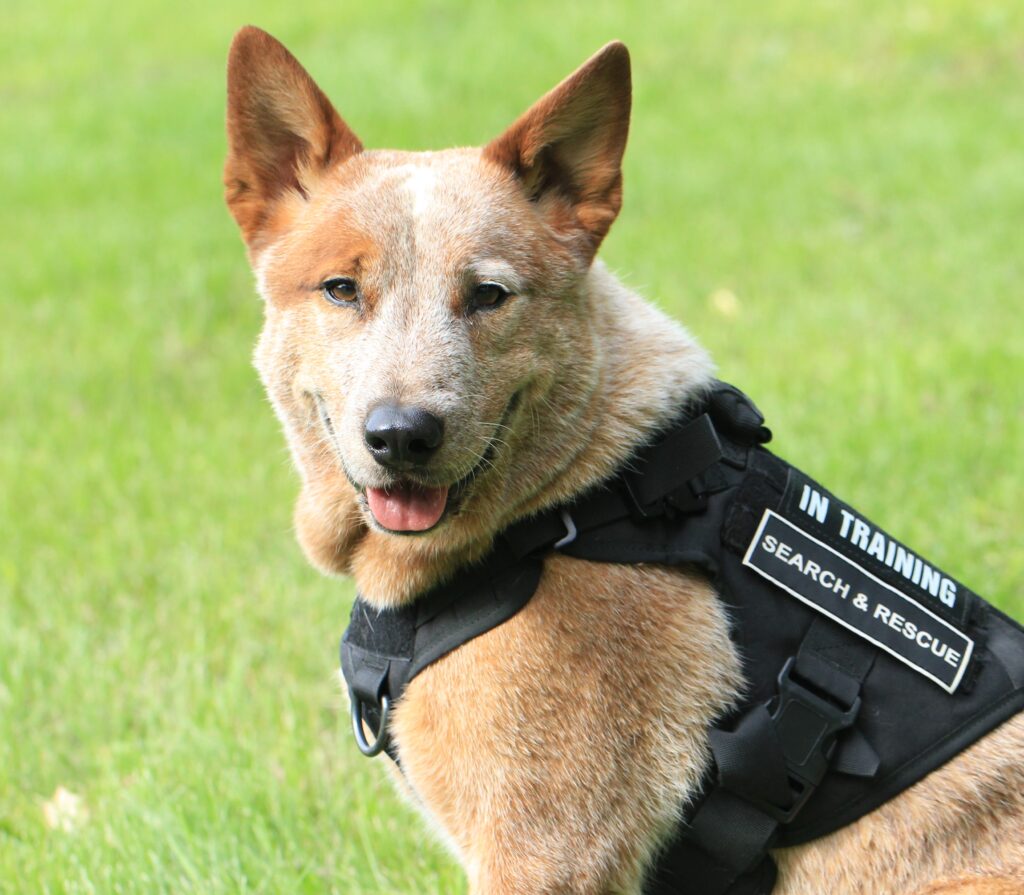
If you love being with and working with your dog, being outside, and constantly looking for more ways to train your dog, you and your dog could become a Search and Rescue (SAR) Dog Team.
Becoming a SAR Dog Team is great for your dog because it’s a physical and mental workout, and it channels their hunting drive. It’s great for you because you will build a great relationship and become in tune with your dog’s body language, natural instinct and movement.
WHAT ARE SEARCH AND RESCUE DOGS?
SAR Dog Teams find people – alive or dead – using a dog’s nose to track or air scent on land, in water or buried in snow (avalanche) either as a one-off incident, or during a disaster. You can teach your dog these behaviours as an enrichment activity or hobby, or even more importantly to help people in your community.
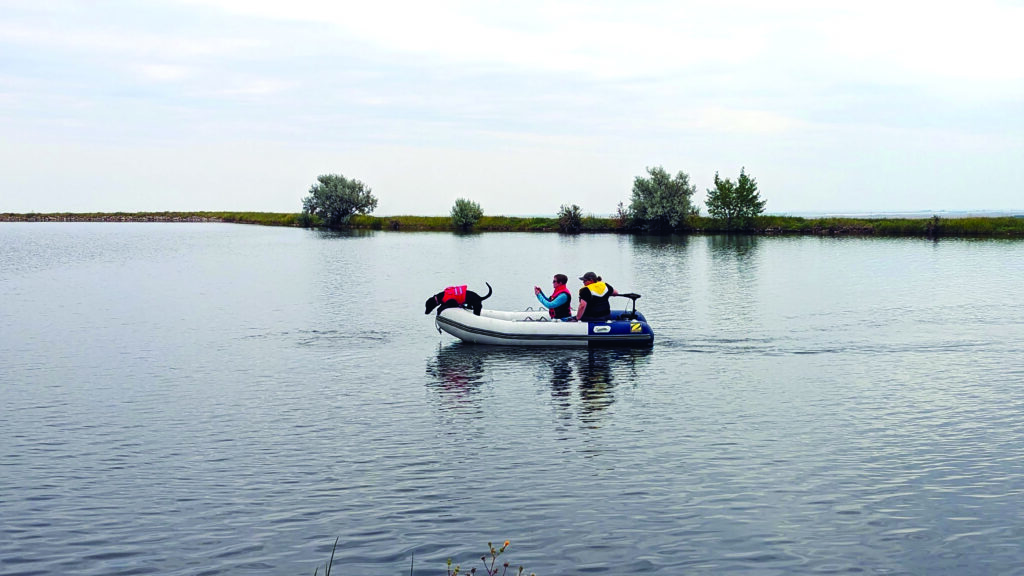
Water SAR Dog Team in training Solo and Erin, along with Amy and Chris, who is diving under water, are with the Lethbridge SAR team.
Tracking leverages a dog’s hunting drive. Dogs use their noses to follow the scent of crushed vegetation made by footsteps, and human scent – bits of skin and bacteria and secretions that waft off our bodies as we go about our days. These human and ground scents interact with environmental conditions such as wind, sun, shade, rain and snow.
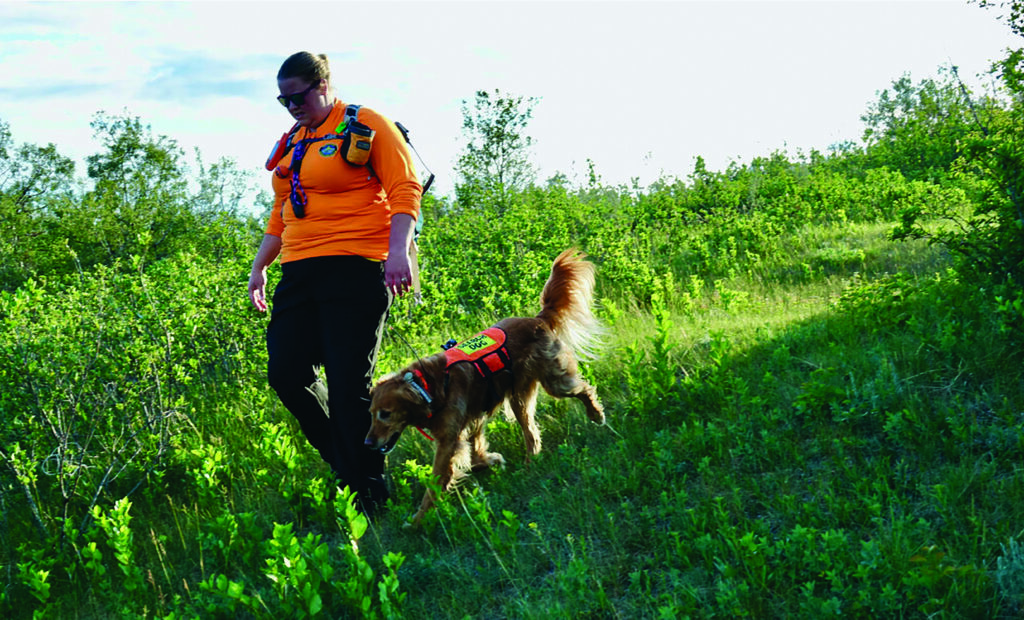
Air Scenting is a less precise behaviour than nose-down tracking, but it is quite effective in wilderness areas with heavy bush and grasses. Air scenting goes by many names, including wilderness searching and ground searching.
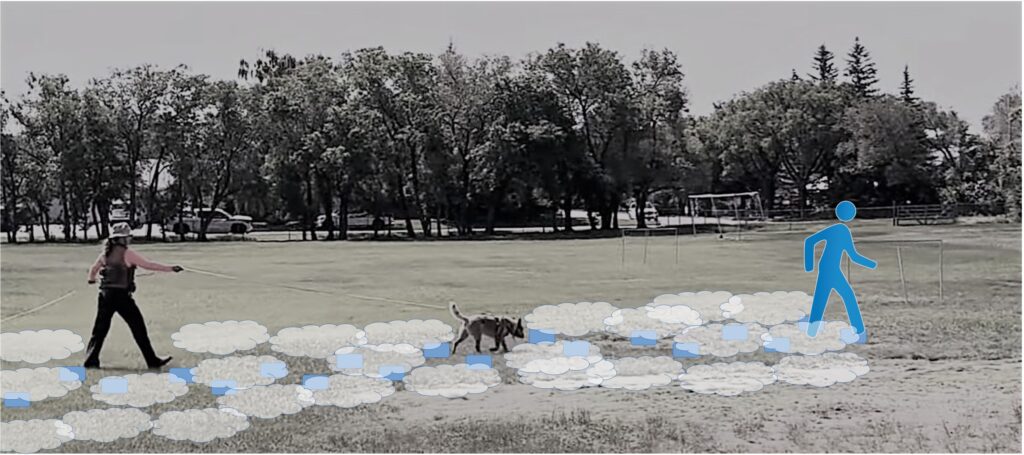
Photo: Dogs hunt human scent, and they must be able to discriminate the target scent from that ofother people and animals, who may also have been in the area. Video still photo is from a Spiritdance Tracking clinic, used with permission, and is further illustrated by Louise Yates.
Tracking Equipment
Tracking is one of the most affordable activities you can do with your dog.
All you need is a harness, which doesn’t restrict your dog’s neck or leg movement, about a 25-foot non- tangling leash, and reinforcement items for your dog. For most dogs, reinforcement items are food or toys and playing with you. And, there is no expensive facility rental costs. You simply head outdoors to practice any time you want.
Articles and Alerts
In both tracking and air scenting, SAR Dogs hunt for people and articles. For training purposes, typical articles are wool socks, leather gloves, pieces of wood or metal such as washers, keys, or cell phones.
To create a scent article, simply have someone hold the article, or place the article under your shirt for a short time, and just like that, the item becomes a human scented article.
In the same way that dogs are trained to alert on or tell you they have found essential oil odours in the dog sport Nosework, they can be trained to alert on scent articles. Show the dog the article. When the dog moves to it, instantaneously say “yes” or use your clicker, then give your dog a tasty treat. Repeat. Move the article around so your dog moves to it. Do it inside. Do it outside. Your dog will soon realize that articles are very important to you, and that it pays very well to find and alert on articles.
When a dog alerts – or tells you they have found the scent article – they tend to naturally move in a unique way; for example, a head snap, tail flick, a look back to you. You can also train a specific alert; for example, stare at the article, sit or lie down beside the article, or stand and bark at it. You can add a cue word such as “show me” to have them motion to the article, or “tell me” for the bark.
Human remains or cadaver SAR training using human tissue,
teeth or bones as scent articles require special handling because they
are biohazards and to prevent cross-contamination.
You can introduce articles to the track, often two to four in total depending on length of the track. SAR dogs must become addicted to the act of tracking, and not only be fixated on the article at the end of the track. Otherwise, the dog can run too fast, miss searching entire areas, and tire their handler out who may not be able to keep up with a running dog, especially on very long tracks.
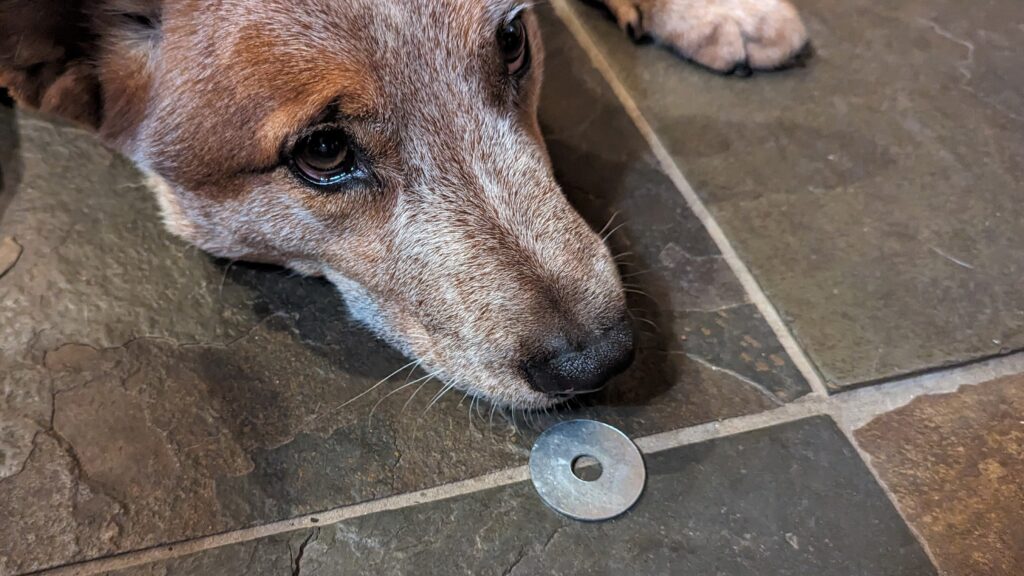
Photo: Local dog trainer Derrick of Fox K9 is an expert tracker, who trains alerts using metal washers as scent articles. His technique helped Seamus really focus on articles.
Water
Water training is very similar to ground SAR K9 Training, except the diver takes the dog’s toy underwater and the dog learns to get their toy back by alerting on the diver’s scent on the water. It can be done from shore or on a boat. Dogs can detect people – dead or alive – underwater by the bubbles and other human scent that come to the water’s surface.
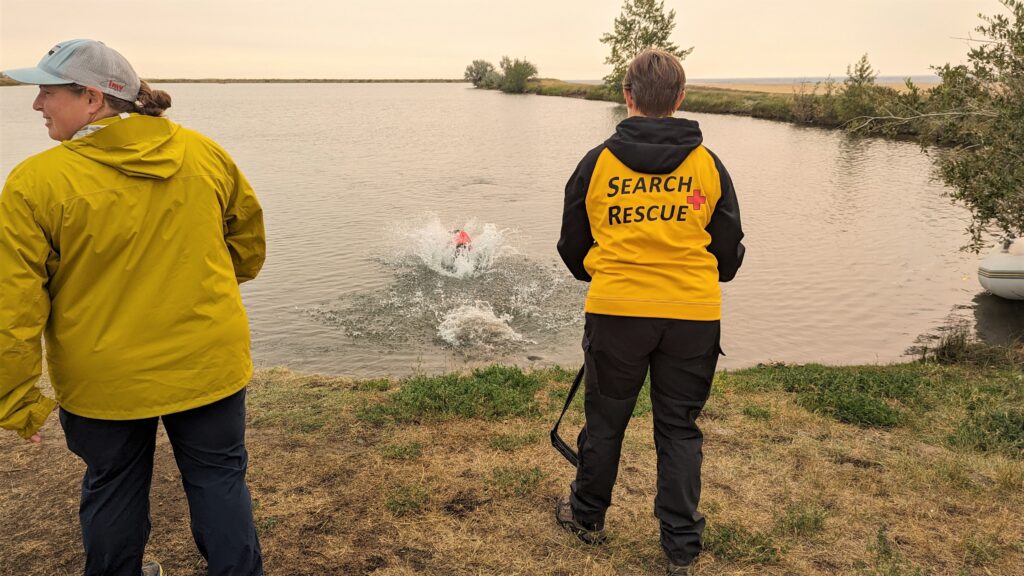
Photo: Solo, Amy, Erin and an underwater driver seen as a ripple in the water with the Lethbridge SAR Team.
Training
SAR Dog Teams spend their own time and money to train, and therefore can train with whomever they prefer. Several private dog trainers offer group and private classes. Very relevant courses for SAR Dog Teams are play-based reinforcement, tracking, air scenting, obedience, and general socialization to be neutral and have impulse control around distractions, including other dogs. Learning how to send or cast your dog away from you to specific locations from herding or hunting dog handlers or trainers also comes in handy. In addition to checking out local trainers, there are plenty of quality online classes and podcasts at your disposal.
As with anything to do with dogs, different people use different training philosophies and methods. Find trainers who fit with your training methods and advocate for your dog. It’s ok to say no to any trainer who wants to do, or wants you to do, something to your dog that you’re not comfortable with.
In tracking and air scenting, let your dog lead the way!
Tracking dogs are taught to be and think independent of their owners. It’s important to not emotionally flatten a dog during training with an excessive use of compulsion. A dog who is trained on the track using harsh corrections will look to their owner for guidance.
However, humans don’t have effective noses, and the dog needs to figure things out. It would be easy to shut down a dog by correcting them, while they are properly scenting. They would quickly learn to look like they are tracking, when in reality, they are not “in scent”. They are just behaving as they were told. It’s also important to not nag and point. By carefully watching your dog’s body language on tracks that you know, you will be better able to hear what your dog is telling you, and really know if your dog is on or off track.
Almost all training is good foundational training for SAR Dogs. There are fantastic synergies between dog sports training and the SAR world. Titling in Rally Obedience, Canine Good Neighbour, and Tracking are obvious choices.

Validation
If you’re interested in tracking and air scenting as a hobby, research more about Mantrailing. It’s a popular dog activity in other jurisdictions and is now catching on in Canada. If you want your SAR Dog Team to officially be deployed to find missing persons through Search and Rescue Saskatchewan Association of Volunteers(SARSAV), you must become a SAR member and validate.
Validation ensures that those helping to find and bring home the missing have the capabilities to do the job, and will help rather than hinder during a real search. Only qualified SAR Teams are allowed to participate in missing person searches.
The Agency Having Jurisdiction (AHJ) – usually a police force – decides who is allowed on site, and what validation standards they accept when someone goes missing. Currently the RCMP and Saskatoon Police Service have authorized civilian SAR Dog Team standards. RCMP F division has
agreements with SARSAV to provide validation to their RCMP Civilian Ground Search and Rescue (GSAR) Dog Standards. Saskatoon Police Service accepts Search and Rescue Dog Association of Alberta (SARDAA) trained SAR Dog Teams validated by the Edmonton Police Services for members of Saskatoon SAR within the City of Saskatoon jurisdiction only.
While other outside organizations offer validations, if you validate to a standard not approved by an AHJ you are working outside of the system, you may be considered as a liability to the search, and will not be deployed by SARSAV as a SAR Dog Team in Saskatchewan.
Most missing person activations in Saskatchewan are called by the RCMP, and they only deploy SAR Dog Teams who have validated against the national RCMP Civilian GSAR Dog Standards, which include tracking, searching, obedience, agility, and temperament. The RCMP definitions for obedience and agility are very different than CKC definitions. The dog must be able to heel, sit, down, heel at a jog and walk, down at heel, stay for five minutes with the handler in sight at least 15 metres away, and recall from 15 metres. Agility is not running through a dog sport agility course. It’s more like parkour where your dog has to be fit and nimble to be able to move through bush and on open fields, jumping over and under things, and have stamina.
Human remains, water, and disaster validation
Currently validation in these profiles is only used by Saskatoon Police Service (SPS) through Saskatoon SAR Dog Teams that have validated to standards approved by SPS.
The RCMP is currently developing cadaver/human remains and avalanche standards, and hopefully one day, there will be a way to validate to those profiles. Choosing to validate to a standard not approved by AHJs in Saskatchewan will mean you are not able to be activated for searches.
Other jurisdictions use outside agencies for validation purposes. Lethbridge Police Service has used SAR dogs validated by International Police Work Dog Association (IPWDA). Ottawa validates under a combination of Ontario Provincial Police for live find and North American Police Work Dog Association (NAPWDA) for human remains. I have also attended a tracking course with an Alberta woman who is a National Association for Search and Rescue (NASAR) evaluator and deploys in Texas.
It’s essential to want to find missing persons by being a SAR member regardless of if your dog ever validates and is eligible to activate.
To prepare your dog, you will have to devote several hours every week training your dog. Know that some dogs develop physically prohibitive medical problems, validations are stressful, and many dogs never pass. Under the current system, if you’re training your dog in human remains, water or disaster work, your SAR Dog Team will not be validated or deployed in Saskatchewan. This may be available in the future.
If you decide to proceed through the RCMP validation process, you must be a member of a SAR chapter, which automatically makes you a member of SARSAV. SAR membership involves providing a criminal record check, taking standard first aid, certifying at the SARSAV Team Leader level, and learning about the command structure in search settings. SARSAV provides entry level to advanced ground search training, and chapter membership also gives you letters of reference from your chapter, and access to bear safety, STARS helicopter landing, navigation and Team Leader level training required by the RCMP.
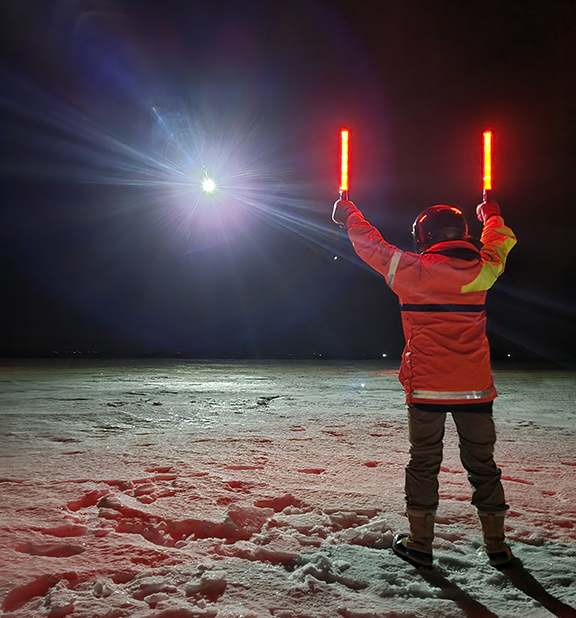
SAR volunteers must be willing to work in the woods, and train during snow storms, rain storms, intense heat, freezing cold and darkness. While training is scheduled in advance, missing person
activations can happen at any time. Having an understanding family and workplace who enable you to drop everything at a moment’s notice for SAR activations is important.
Quick Start: Tracking
I have worked with several trainers, and they all do things differently, however, almost all of them use a variation of the following method:
• The track has three elements. Track in, the track, and track out. On cut grass, take about 10 steps in, lay a “scent pad” by stomping around a little bit and sprinkling a bit of food, then lay the track by taking about 10 to 15 very close steps in a straight line and placing a treat into the heel of each footstep. Track out by taking a few steps out of the track without laying down food.
• At the start of the track, place the dog into their harness, which will become your starting ritual, and give a cue word such as “find it”, “track”, “search” – whatever you prefer.
• The dog follows the track and eats the food, which directly positively reinforces the dog. Repeat so the dog develops a positive conditioned emotional response to the track, and a nose-down attitude.
Gradually:
• move to a variable rate of reinforcement by spacing the treats out – some closer together, some further apart;
• increase the length of the track;
• introduce left and right turns, ideally, about a meter and a half after the turn, place food on the track. (TIP: When just starting, lay your track so it dead ends at a building or fence so your dog has fewer options and must choose to go left or right.);
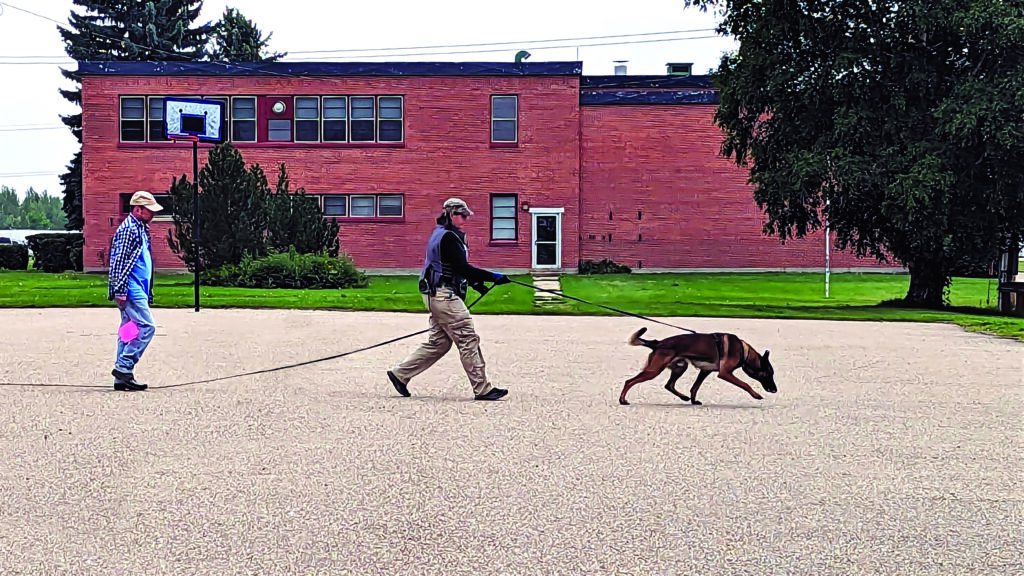
• move to different substrates – i.e. from short grass to concrete to long grass to asphalt – where there are different environmental distractions – i.e. traffic, bunnies, children, buildings, etc.; and,
• age the track by laying it, waiting a bit, then having your dog run the track.
• Eventually, get rid of the food completely.
• Always, end with a huge celebration between you and your dog. Play with your dog! Have a party! At the end of a track, your dog should feel like they’ve just done their best job ever!
Gradually make progress increasing track distance, environmental distractions, and duration between laying and running the track one at a time. Don’t increase all three factors simultaneously.
Using this method, Seamus learned how to keep his head down and drive his nose into the track. We are still working to increase the distance, focus through distractions, and duration of the track. Know that there are many other methods to train, and use one that works for your dog.
After your dog understands tracking, you will introduce articles and alerts.
This Sit. Stay. Search. video is about BC SAR Dog Teams. The RCMP developed the national standards in 2016 to create consistency, minimize confusion and become more efficient across the country. The video references the changes to the standards because since the tracking profile became mandatory, it is proving to be difficult for many previously validated SAR Dog Teams to pass. It’s essential to train tracking and scenting profiles equally.
Quick Start: Air Scenting
Air scenting SAR Dogs tend to keep their noses higher in the air to locate a person. To a dog, it’s really just an extreme game of fetch so it works best with dogs who love to play with toys. For this SAR profile, the dog is off-leash not wearing a harness. Again, there are lots of ways to train this behaviour. Use one that works for your dog.
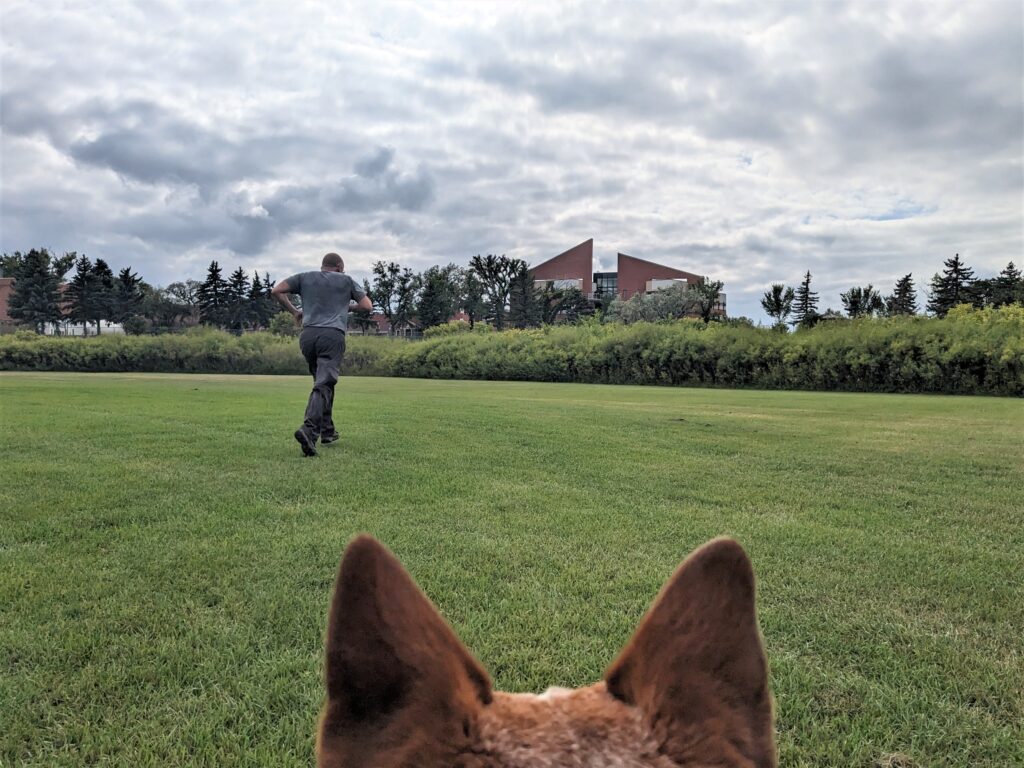
Air scenting is done with a “run away” where someone runs away with the dog’s favourite toy, and the dog, after being restrained, excitedly runs to find the person, and, of course, their toy.
• Enlist a friend to hold your dog’s leash to restrain the dog, while you run away with your dog’s favourite toy.
• Your friend will give a different cue word than you use for tracking, then will release the dog to run to you. Give the dog their toy, celebrate and play. Repeat so your dog understands the game.
• After several practice rounds, if you have already trained a “show me” or “bark” alert, ask your dog to do their alert at the end of the track before handing the toy over to celebrate and play. Repeat.
• Increase the distance that you run, or the difficulty by hiding behind trees or in longer grass.
• Switch it up by having your friend run away with the toy instead of you.
• Practise in different locations and larger spaces with lots of distractions.
• Enlist other people to run away so your dog is able to find other people.
• Eventually, you will teach your dog to cast back and forth in front of you working into the wind to cover large areas.
If you’re interested in learning more about SAR dogs, here are some excellent SAR resources.
Audio interview with Ottawa Valley Search and Rescue Dog Association team leader, Kim Cooper.
Doyle, Mike, Facts and Figures for the Search Manager, Search Dog Handbook, The Boxwood Press, 183 Ocean View Blvd., Pacific Grove, CA 93950, 1992.
Scandinavian Working Dog Institute Self-Study Courses App (with in-app purchases)
Gerritsen, Resi, Rudd Haak, K9 Search and Rescue: A Manual for Training the Natural Way, Dog Training Press; 2 edition (Sept. 4 2014).
Tracking
A Podcast introduction to Tracking
https://controlledaggressionposcast.libsyn.com/intro-police-k9-hard-surface-tracking
Two podcasts about nose/scent-related dog topics: K9 Detection Collaborative and K9s Talking Scents.
Sanders, William (Sil) Modern Enthusiastic Tracking: The new step-by-step training handbook, 2017. Available at Amazon.
Human Remains or Cadaver SAR
Rebmann, Andres, Edward David, and Marcella H. Sorg, Cadaver Dog Handbook, forensic Training and Tactics for the recovery of human remains, 2000, available as a free download at archive.org
Louise Yates
Retired owner K-Lane Kennels | SAR Regina Member and Director